































Chest Compressions and AED Use to Improve Survival Rates
Current Situation of Sudden Cardiac Death
Prompt CPR and defibrillation are essential for saving someone experiencing ventricular fibrillation. For every one-minute delay in defibrillation, the chance of survival decreases by 10%.
The average time from an emergency call to ambulance arrival is approximately 9.4 minutes. If appropriate first aid is provided before then, the chances of survival increase. When first aid is provided before emergency personnel arrive, approximately twice as many people are alive one month later.
Waiting for emergency personnel or a doctor to arrive may be too late to save a life. In the event of sudden cardiac arrest, you may be the only person who can save a life.

Resuscitation Procedure
Start and Continue Chest Compressions (Cardiac Massage) and Use an AED
- Find a Person in Need of Assistance

Check that the surrounding area is safe before approaching.
- Check for Responsiveness (Consciousness)
Tap the person on the shoulder and speak to them.
- Call 119 / Request an AED
Call 119 for an ambulance, arrange for an AED, and ask as many people as possible to help.
- Check Breathing and Determine Whether to Start Chest Compressions
If the person is not breathing or is breathing abnormally, treat it as cardiac arrest.
(When checking breathing, make sure the chest is clearly rising.)
▼
Begin chest compressions immediately.(Chest compressions alone are acceptable.)
(If you are unsure whether the person is breathing normally, begin chest compressions.) - Chest Compressions

Press on the lower half of the flat bone in the center of the chest (sternum): hard, fast, and continuously!
● Hard: About 5 cm deep for adults
● Fast: At a rate of 100 to 120 compressions per minute
● Continuously: Keep interruptions to a minimum
Work together with those around you and continue chest compressions. (If giving rescue breaths, repeat cycles of 30 chest compressions followed by 2 rescue breaths.)
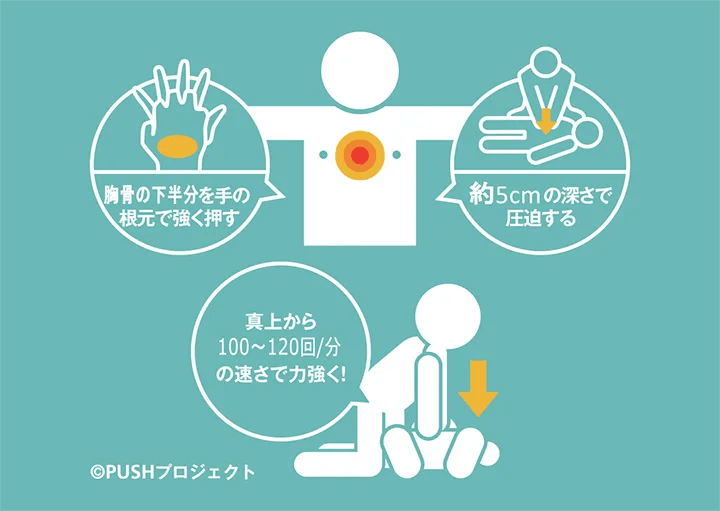
Source: Non-Profit Organization Osaka Life Support Association
- Defibrillation
As soon as the AED arrives, turn it on and follow its instructions.
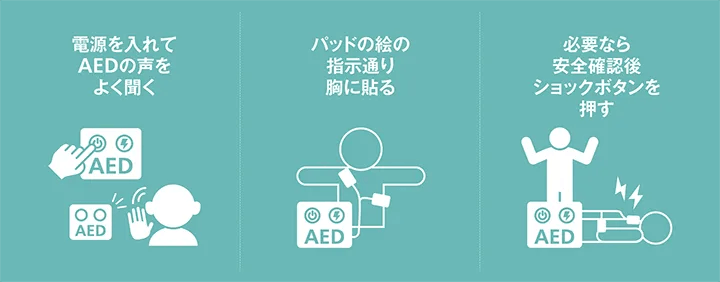
Source: Non-Profit Organization Osaka Life Support Association
- Chest Compressions
Resume chest compressions immediately after delivering a shock.
(If no shock is delivered, resume chest compressions if the person is still unresponsive and not breathing.)
The AED will check every two minutes to determine whether another shock is needed, so follow its instructions.
- (Repeat)
Above all, keep interruptions to chest compressions to a minimum and continue until the person is resuscitated.
Purpose and Important Notes
- Immediately after a person collapses, the cause is often ventricular fibrillation, and the only treatment for ventricular fibrillation is defibrillation with an AED.
- The role of an AED is to stop ventricular fibrillation; it is not a device that makes the heart start beating.
- The heart does not necessarily start beating immediately after a shock is delivered.
- Chest compressions, not just an AED, are necessary to circulate blood to the heart and brain.